Basic grammar
1.Câu (Sentence):
1.1 Câu đơn (Single sentence):
1.1.1 Câu khẳng định (Affirmative sentence) (+):
A. Definition:
Câu khẳng định (Affirmative sentences) are also known by other names such as declarative sentences, narrative sentences, and descriptive sentences. This type of sentence is used to express and verify information, objects, events, phenomena, etc.
B. Structure:
Unlike English, the structure of affirmative sentences in Vietnamese is simpler.

C. Common tense:
In this aspect, Vietnamese grammar is more straightforward than English, as it does not require verb conjugation for tense distinctions.

We only need to sequentially replace “đã, sắp, vừa/mới, sẽ” with “đang” to achieve the correct sentence structure.
However, in Vietnamese, most sentences do not necessarily require “đã, đang, vừa/ mới, sắp, sẽ” as context and time indicators often suffice.
| Tense | Structure | Example |
|---|---|---|
| Past | S + đã + clause | Tối hôm qua, anh ấy đã về nhà trễ. (Yesterday night, he returned home late) |
| Present continuous | S + đang + clause | Chúng ta đang học tiếng Việt. (We are studying Vietnamese) |
| Present perfect | S + vừa/ mới + clause | Ông ấy vừa (mới) đi ra ngoài. (He has just left) |
| Near future | S + sắp + clause | Trời sắp mưa. (It is about to rain) |
| Future | S + sẽ + clause | Tuần sau, họ sẽ đi du lịch. (Next week, they will go traveling) |
The following are common time adverbs that facilitate easier identification of tenses:

1.1.2 Câu phủ định (Negative sentence) (-)
A. Definition:
Câu phủ định (Negative sentences) are sentences used to express an opinion about something that is wrong or not true, an action that did not happen, or to express the speaker or writer’s disagreement.
Basically, negative sentences refer to *“không”* (not having, not doing, not understanding, not going, no one, nothing…)
B. Structure:

When the negation is emphasized:

We also can use “Ai” for anyone and “Đâu” for anywhere in Negative sentence:


1.1.4 Câu hỏi (Question)(?)
A. Câu hỏi có hoặc không (Yes/ No question):
Definition: It is a type of question where the answer is either “yes” or “no.”
In Vietnamese, this sentence structure is uncomplicated; it involves adding “A” at the end of the sentence and adjusting the pronoun to properly address the person being asked.
Types:
Yes/ no question:

Confirmation question:
This structure is employed when the first person already possesses information from the second person and seeks to confirm the accuracy of the knowledge or theory they have (It is quite similar to tag questions in English.)

Question to ask for permission:
It is used when the first person politely asks for permission to do something with the second person, in a courteous and formal manner.

Question to ask for posibility:
It is used when the first person asks the second person if they are capable of doing something.

B. Câu hỏi mở (Open-ended question)
Definition: is a type of question that does not have a fixed answer, requiring respondents to think and give their own answers.
Từ để hỏi (Question form):
| Vietnamese | English | Example |
|---|---|---|
| Gì | what | Anh thích ăn gì? (what do you like to eat) |
| Mấy | how many (countable) | Chị có mấy áo? (How many top does she have) |
| Bao nhiêu | how many (uncountable) | Ly cà phê này bao nhiêu tiền? (How much does a glass of coffee cost?) |
| (Tại) sao | why | (Tại) sao hôm qua anh về nhà trễ? (Why did you go home late yesterday?) |
| Ở đâu | where | Em muốn uống sinh tố ở đâu? (Where do you want to drink smoothie?) |
| Ai | who (as Subject) whom (as Object) | –Ai lấy chìa khóa của tôi? (Who took my key?) -Anh sẽ đi du lịch với ai? (Who will you go traveling with?) |
| Nào | which | Em thích uống trà nào? (Which tea do you like to drink?) |
| Mấy giờ | what time | Mấy giờ em về nhà? (what time do you go home?) |
| Khi nào | when | Khi nào anh ấy quay lại Việt Nam? (When will he return Vietnam?) |
| Như thế nào/ sao | how | Anh ấy trông như thế nào? (How does he look like?) |
Note: Unlike the structure in English, Vietnamese is more logical in that depending on the response, we can adjust the pronouns and question words to form a question that aligns with the information we seek.

C. Câu hỏi dạng khẳng định (Affirmative question)
Definition: This type of sentence is used to affirm that certain actions or events will definitely happen or have happened.
Example:

| Vietnamese | English | Example |
|---|---|---|
| ….chứ ai? …không…thì ai làm? |
who else if you didn’t….then who did? |
Chị làm chứ ai? (You did this, who else?) Chị không làm thì ai làm? (If you didn’t do then who did?) |
| ….chứ sao? | Of course | – A: Chị làm được rồi! Chị giỏi quá – B: Chứ sao? (– A: You did it! Well done! – B: Sure thing) |
| …..không…..thì khi nào nữa? | If not now, then when? | Bây giờ em không làm thì đợi khi nào nữa? (If you don’t do it now, then when will you?) |
| chứ còn gì nữa | nothing else left to add / I can’t agree more / definitely | – A: Vậy ông ấy nghỉ việc rồi à? – B: Chứ còn gì nữa? (– A: so he quit his job, didn’t he? – B: That’s right) |
| chứ đâu | where else (could it be) | Cô ấy về quê rồi chứ đâu? (She went back her hometown, where else could it be?) |
D. Câu hỏi tu từ (A rhetorical question):
Definition: A rhetorical question is a question that is asked by a person but does not aim to find an answer, or the content of the answer is already available in the question.
Example:


Note:
PT = Phó từ (Adverb)
ĐTKK = Động từ khiếm khuyết (Modal verb)
“Mình” is used to address I/ myself in the frienly way
E. Câu hỏi lựa chọn (Choice questions):
Definition: is a type of question that presents two or more options for the respondent to choose one of. This is an effective way to clarify someone’s preferences or opinions on a particular issue.
Example:

1.2 Câu ghép (Compound sentences): 1.2.1 Quan hệ từ/ Liên từ (Conjunction):rồi, thì, nhưng, hay, hoặc,
A. Definition:
Conjunctions are words used to connect words with the same function in a clause, or to connect clauses of the same type, or to connect main clauses and subordinate clauses together.
B. Type of Conjuction:
| Vietnamese | English | Example |
|---|---|---|
| Bằng | by | Tôi đi làm bằng xe máy (I go to work by motorbike) |
| Với | with | Anh ấy thích đi du lịch với bạn gái (He likes to go traveling with his girl friend) |
| Của | of (possession) | Đây là nhà của tôi (This is house of mine) |
| Về | about | Chị ấy thường nói về gia đình (She usually speaks about family) |
| Cho | for | Tôi sẽ mua cho bạn một ly cà phê sữa (I will buy for you a glass of milk coffee) |
| Nhưng | but | Ông ấy muốn đi xem phim nhưng ông ấy bận rồi (He wants to go to watch movie but he is busy already) |
| Từ | from | Từ Hồ Chí Minh đến Vũng Tàu chỉ mất 2 tiếng đi xe ô tô (From Ho Chi Minh to Vung Tau just takes 2 hours by car) |
| Đến | to (till) | Chị ấy làm việc đến tám giờ tối (She works till 8pm) |
| Và | And (connects 2 Nouns/Verb/Adj) | Cô ấy thích ăn cá và bò (She likes to eat fish and beef) |
| Hay | Or | Em thích uống trà hay cà phê ? (You like to drink tea or coffee?) |
| Còn | And (connects 2 sentences) | Anh ấy cao còn vợ anh ấy thấp (He is tall and his wife is short) |
| Cũng | also | Tôi thích uống sữa, bạn tôi cũng thích uống sữa (I like to drink milk and my friend also like to drink milk) |
| Đều | all/ both (expresses similarity, uniformity in the action, state) | Bà ấy và tôi đều là người Việt (She and I both are Vietnamese) |
1.2.2 Cặp quan hệ từ (Correlative conjunction):
A. Definition:
Paired conjunctions, also called correlative conjunctions are two linking words that relate to one another and are used in one sentence. Common pairs of conjunctions include:
B. Type of Correlative Conjunction:
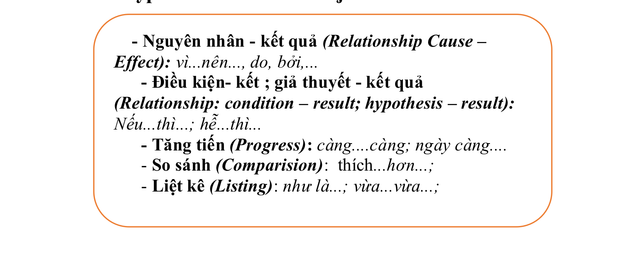
Nguyên nhân – kết quả (Relationship Cause – Effect):
To express the cause-effect relationship between two clauses of a compound sentence, you can use: vì, bởi vì, do, nên, cho nên
Pair of conjunction: vì….. nên (cho nên), bởi vì….nên (cho nên)

In another context, Vietnamese speakers utilize the expression “tại” to emphasize and lend credibility to their justifications or reasons.
Example: Tại tối qua tôi không ngủ được nên tôi đi làm trễ (I couldn’t sleep last night so I went to work late)
Note: It is also possible to rearrange the clauses and omit the use of “V씶

Điều kiện- kết ; giả thuyết – kết quả (Relationship: condition – result; hypothesis – result): Nếu…thì…; hễ…thì…
| Vietnamese | English | Example |
|---|---|---|
| Nếu…thì… | If….then…. | Nếu anh ấy không gọi thì tôi đã không biết (If he didn’t call then I wouldn’t know) |
| Giá như / phải chi / biết vậy | If only | Phải chi cô ấy hiểu tiếng Pháp, cô ấy đã có thể làm ở công ty đó (If only she understood French, she could work at that company.) |
| Ước gì | Wish | Ước gì tôi có nhiều tiền hơn để giúp người khác (I wish I had more money to help others.) |
| Đáng lẽ…nên…. | (S) should have | Đáng lẽ chị ấy nên ở nhà nghỉ ngơi (She should have stayed home to rest) |
| Không lẽ | It makes no sense if | Nhà anh ấy giàu vậy, không lẽ anh ấy không có tiền đi du lịch (His family is so rich, it makes no sense if he doesn’t have money to travel) |
| Thà… hơn là…. | would rather… | Thà tôi ở nhà, hơn là tôi đi du lịch vào dịp Tết (I would rather stay at home than go on a trip during Tet.) |
| Phòng khi / lỡ | in case | Em nên mang dù phòng khi trời mưa (You should bring an umbrella in case it rains) |
| Nếu không là / không thôi là / kẻo | otherwise | Anh phải nhanh lên nếu không là sẽ trễ giờ! (You must hurry otherwise you will be late!) |
| Trừ khi.. / trừ trường hợp | unless | Nó sẽ không về nhà trừ khi mẹ nó đi tìm nó (He won’t come home unless his mother comes looking for him.) |
Tăng tiến (Progress): càng….càng; ngày càng
| Vietnamese | English | Example |
|---|---|---|
| …càng…càng | the more…the more | Chị càng tập nói tiếng Việt nhiều, chị càng giỏi. (The more you practice speaking Vietnamese, the better you get.) |
| ngày càng…. | ..is getting…(day after day) | Cô ấy nhìn ngày càng trẻ (Her look is getting younger and younger) |
| …thậm chí còn…. | even | Ông ấy thậm chí còn không nhìn tôi một lần (He didn’t even look at me once.) |
| …dần dần… | gradually | Anh ấy dần dần thấy khỏe hơn (He gradually got better) |
Liệt kê (Listing): như là…; vừa…vừa…;
| Vietnamese | English | Example |
|---|---|---|
| …vừa…vừa… | not only….but also… | – Bà ấy vừa giỏi vừa tốt bụng (She is not only good but also kind) – Tôi vừa ăn sáng vừa dùng điện thoại (I’m having breakfast and using phone) |
| …như là: | such as | Việt Nam có nhiều cảnh đẹp như là: Ninh Bình, Đà Lạt, Nha Trang,…(Vietnam has many beautiful landscapes such as: Ninh Binh, Da Lat, Nha Trang,…) |
| ….thì….thì…. | listing action or things (connect 2 sentences) | Anh ấy thì làm việc, tôi thì ngủ (He works, I sleep) |
| …vả lại…. | but also | Cô ấy rất thích công việc này, vả lại lương cũng cao (She really likes this job, but also the salary is high.) |
| …rồi…. | then | Em đi thẳng đường này rồi rẽ phải ! (You go straight this way then turn right.) |
So sánh (Comparison): thích …hơn…;hơn; giống như,….
+ So sánh bằng (Equal Comparison): is the comparison between things and events at the same level. Equal comparison is when we compare equal things and events.
| Vietnamese | English | Example |
|---|---|---|
| là | (to be) | Anh ấy là người Mỹ (He is American) |
| như / giống như / y như | like | Cô ấy thông minh như mẹ cô ấy (She is smart like her mom) |
| bằng | as…as… | Không ai đẹp bằng chị ấy (No one is as pretty as her) |
| khác với | different from | Dù là mẹ con nhưng tính cách con gái rất khác với bà ấy (Even though they are mother and daughter, but her daughter’s personality is very different from hers) |
+ So sánh hơn (Comparative): used when comparing the properties and characteristics of two things or events to see their differences.
Unlike English, which has short and long adjectives, in Vietnamese, we simply add “hơn” after the adjective.

+ So sánh nhất (Superlative): used to evaluate the outstanding characteristics and differences of an object compared to a group, that group contains at least 3 objects or more.
We add “nhất” after the adjective to form the superlative sentence structure.

Khác(Others): trong khi..; ít nhất là….; cho đến khi….;
| Vietnamese | English | Example |
|---|---|---|
| ...khi... | when | Anh ấy thường đi du lịch khi anh ấy rảnh. (He usually goes traveling when he is free.) |
| trong khi | meanwhile | Chị ấy bận làm việc trong khi anh ấy chỉ xem phim cả ngày. (She is busy at work meanwhile he just watches movies all day.) |
| cho đến khi | until | Tôi sẽ không ra ngoài cho đến khi trời hết mưa. (I will not go out until the rain stops.) |
| trước khi | before (+ clause) | Tôi thường ăn sáng trước khi đi làm. (I usually have breakfast before going to work.) |
| sau khi | after (+ clause) | Cô ấy thường tập thể dục sau khi cô ấy thức dậy. (She usually does exercises after she wakes up.) |
| từ khi | since | Bà ấy rất vui từ khi làm việc ở công ty này. (She has been very happy since working in this company.) |
| ngay khi | as soon as | Ông ấy gọi cho gia đình ngay khi đến Việt Nam. (He called his family as soon as he arrived in Vietnam.) |
| ít nhất là | at least | Anh ấy không giàu nhưng ít nhất là anh ấy có công việc. (He is not rich but at least he has a job.) |
| miễn là | as long as | Chúng tôi sẽ đi picnic vào chủ nhật miễn là trời không mưa. (We will go picnic on Sunday as long as there is no rain.) |
| chỉ…..thôi | ....only.... | Tôi chỉ có một anh trai thôi. (I only have one older brother.) |
| …..có... hay không? | whether or not? | Tôi không biết tôi có nên đi hay không? (I don’t know whether I should go or not?) |
| ….nào cũng….. | All / Every (Subject focus) | Cô gái Việt Nam nào cũng xinh đẹp. (All Vietnamese girls are pretty.) |
| ….nào…cũng… | Every (Object/Time focus) | Ngày nào anh ấy cũng đi tập gym. (He goes to the gym every day.) |
| …đã…… chưa? | Have you... yet? | Em đã ăn sáng chưa? (Have you had breakfast yet?) |
| …đã bao giờ….chưa? | Have you ever...? | Anh đã bao giờ đi Mỹ chưa? (Have you ever been to the USA?) |